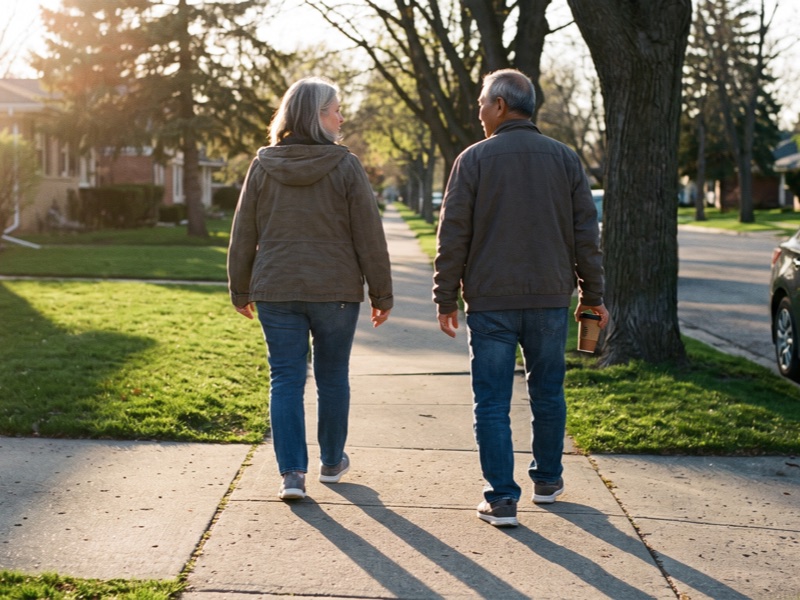
The 10-minute walk after meals: what it does to your blood sugar
The trial numbers, why timing matters more than distance, and how to fit three short walks into a normal workday.
Convert your daily step count into miles and kilometers using a stride length estimated from your height, with walking time at 3 mph and a rough calorie figure.
Distance uses a step length estimated from your height (0.413 × height for women, 0.415 × height for men), the convention most pedometers use. Minutes assume 3 mph on level ground; calories use 3.5 METs and are a rough estimate. Measuring your own stride over 100 feet gives a better number.
A step counter knows how many times you moved, not how far. To turn steps into miles you need your step length, and this calculator estimates it from your height using the convention most pedometer makers use: about 0.413 times height for women and 0.415 times height for men. A 5'4" woman gets a step of about 26.4 inches, roughly 2,400 steps per mile. Her 10,000 steps come to 4.17 miles, or 6.71 km.
Minutes assume a 3 mph pace: 20 minutes per mile, or 100 to 115 steps a minute for most adults. Tudor-Locke and colleagues use 100 steps per minute as the rough floor for moderate-intensity walking, the kind that counts toward the CDC's 150 minutes a week.
Enter your weight and you get a rough calorie figure. Level walking at 3 mph is rated at 3.5 METs in the 2011 Compendium of Physical Activities: for a 160 lb person, roughly 4.5 calories a minute, 90 a mile, and 350 to 400 for 10,000 steps.
The old rule assumes a step of about 31.7 inches, or 2.6 feet. That is a long step: at pedometer conventions it belongs to someone well over six feet, or to an average-height person walking briskly, since steps lengthen with speed. At 5'7" and an everyday pace the calculator gives about 2,290 steps per mile; at 5'2" it is close to 2,500. For the same 10,000 steps, that is the difference between 4.0 and 4.7 miles.
Two minutes with a tape measure beats any formula. Mark off 100 feet on a sidewalk (or 30 meters), walk it at your normal pace, and count your steps. Divide distance by count: 100 feet in 42 steps is 2.38 feet, or 28.6 inches, per step. Do it twice and average. Most pedometers and apps let you enter a custom stride, and that one entry fixes most of the error in the miles they report.
Common daily totals at three heights, using the female factor; a man of the same height lands within about one percent.
| Steps | 5'2" (about 2,470 steps/mile) | 5'7" (about 2,290 steps/mile) | 6'0" (about 2,130 steps/mile) |
|---|---|---|---|
| 2,500 | 1.0 mi · 1.6 km | 1.1 mi · 1.8 km | 1.2 mi · 1.9 km |
| 5,000 | 2.0 mi · 3.3 km | 2.2 mi · 3.5 km | 2.3 mi · 3.8 km |
| 7,500 | 3.0 mi · 4.9 km | 3.3 mi · 5.3 km | 3.5 mi · 5.7 km |
| 10,000 | 4.0 mi · 6.5 km | 4.4 mi · 7.0 km | 4.7 mi · 7.6 km |
| 12,500 | 5.1 mi · 8.1 km | 5.5 mi · 8.8 km | 5.9 mi · 9.4 km |
| 15,000 | 6.1 mi · 9.8 km | 6.6 mi · 10.5 km | 7.0 mi · 11.3 km |
The 10,000-step target did not come from a study but from a Japanese pedometer sold in 1965 as the manpo-kei, "10,000-step meter." Tudor-Locke and Bassett's 2004 pedometer scale called under 5,000 steps a day sedentary, 5,000 to 7,499 low active, 7,500 to 9,999 somewhat active and 10,000 or more active.
Two newer studies matter more. In a 2019 JAMA Internal Medicine study of 16,741 older women (average age 72), those averaging about 4,400 steps a day had 41 percent lower mortality than those averaging about 2,700, and the benefit leveled off around 7,500. A 2022 meta-analysis of 15 cohorts in The Lancet Public Health (47,471 adults) found the risk of death kept falling until about 6,000 to 8,000 steps a day for people 60 and older, and 8,000 to 10,000 for younger adults, then flattened.
Not a ranking, in no particular order. How we make money.
The cheap option: a clip-on 3D pedometer with one big number on the screen, no app, no charging, and a lanyard for people who do not carry a phone; it counts steps only, so you do the miles here.
A slim wrist tracker with steps, distance, heart rate and sleep in the Fitbit app, and a battery that lasts about a week; distance is estimated from a stride you can set yourself, which is worth doing.
A cushioned, neutral road shoe that many podiatrists point walkers toward and that comes in wide sizes; it is not cheap, so try last year's Ghost 15 on sale if the price stings.
Between roughly 2,100 and 2,500 for most adults, depending on height and pace. At 5'2" it is about 2,470 steps per mile, at 5'7" about 2,290, and at 6'0" about 2,130. The common "2,000 steps per mile" figure assumes a long step of about 2.6 feet, which fits a tall person or a brisk pace.
About 4 to 4.7 miles, or 6.5 to 7.6 km. A 5'2" woman covers roughly 4.0 miles in 10,000 steps, a 5'7" person about 4.4 miles, and a 6'0" man about 4.7 miles. At 3 mph that is around 80 to 95 minutes of walking spread over the day.
Roughly 2 to 2.4 miles, or 3.3 to 3.8 km, depending on your height. That is about 40 to 45 minutes of walking at 3 mph. Five thousand steps a day was the cutoff for "sedentary" in Tudor-Locke and Bassett's 2004 pedometer scale, so it is a floor to move up from rather than a goal.
Multiply your steps by your step length in meters. Step length is about 0.413 times height for women and 0.415 times height for men, so a 170 cm woman has a step of about 0.70 m and takes roughly 1,420 steps per kilometer. Ten thousand steps for her is about 7.0 km. Measuring your own stride over 30 meters gives a more accurate factor.
For walking, about 2.2 to 2.5 feet (26 to 30 inches) per step for most adults, which is the distance from one foot strike to the next. Some devices call the distance covered by two steps a "stride," which is about 4.5 to 5 feet. Check which definition your pedometer or app uses before you type a number in.
The research points to a plateau rather than a magic number. In a 2022 meta-analysis of 47,471 adults, mortality risk stopped falling around 6,000 to 8,000 steps a day for people 60 and older and around 8,000 to 10,000 for younger adults. A 2019 study of older women found benefits starting at about 4,400 steps and leveling off near 7,500. Ten thousand came from a 1965 pedometer marketing campaign, not a trial.
This calculator is for general information and is not medical advice. Results are estimates from population formulas and can be off for you personally. Talk to a clinician before acting on a number, especially if you take medication or have a diagnosed condition. Editorial policy · Medical disclaimer
The trial numbers, why timing matters more than distance, and how to fit three short walks into a normal workday.
Bone density, hearing, colon, eyes, skin, blood pressure, vaccines, strength. Eight appointments, one year, with what each one catches.