Clocks go back Sunday: how to reset your sleep in three days
Daylight saving time ends Sunday, November 1. Who feels it most, and the three-night plan that starts Thursday.
Muscle takes up glucose without insulin while it moves. Ten minutes after each meal beats one long walk a day.
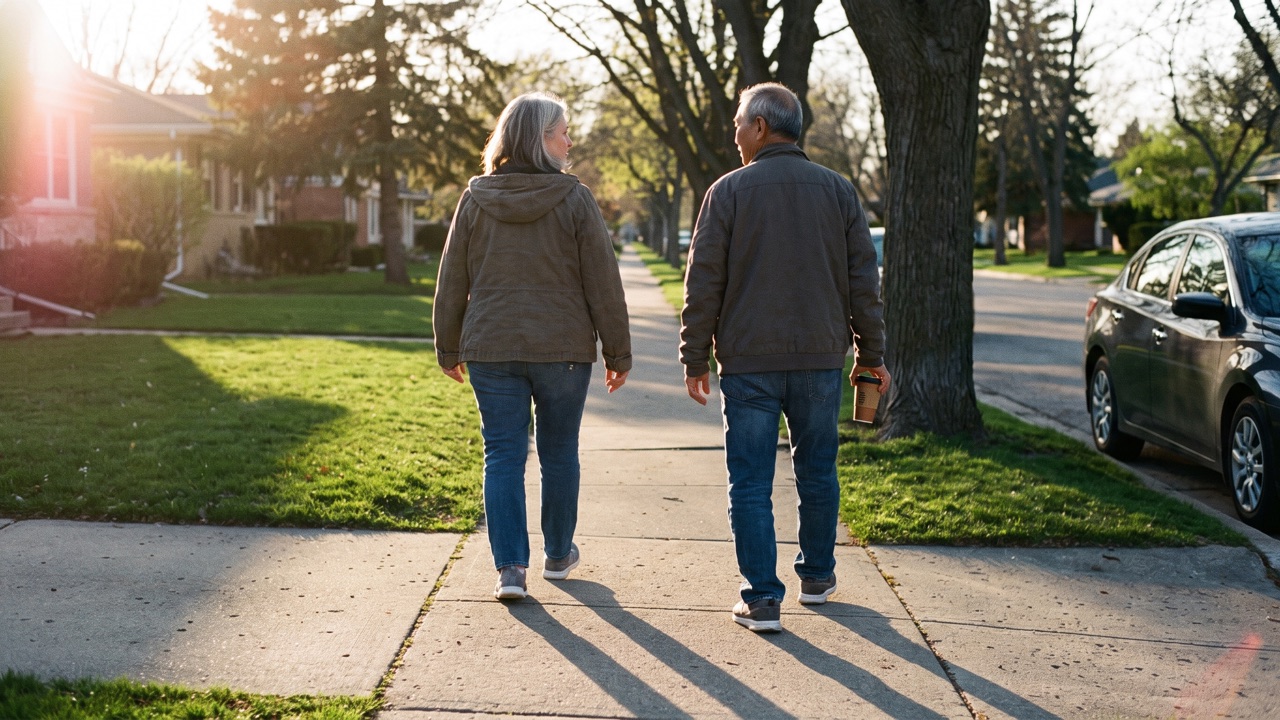
You finish dinner, clear the plates, and sit back down. For the next two hours, while you scroll or watch something, the sugar from that meal is moving into your blood faster than your body can move it out. If you have prediabetes or type 2 diabetes, that after-dinner curve is where your A1C is quietly built.
There is a low-tech way to blunt it. Not a supplement, not a stricter diet: standing up and walking, slowly if you like, for about ten minutes after each meal rather than once a day.
Why it works comes down to how muscle pulls glucose out of the blood. Why the timing matters comes from a trial that measured it.
Most of the time, glucose gets into muscle because insulin knocks on the door. Insulin tells the cell to move transporters called GLUT4 to its surface, and glucose flows in. In insulin resistance, that knock is heard less clearly, so more sugar stays in the blood.
A contracting muscle opens the same door through a different signal. Contraction itself, via calcium release and an energy sensor called AMPK, pushes GLUT4 to the cell surface. That route works even when insulin signaling is impaired, which is why people with type 2 diabetes still see glucose fall during activity. Richter and Hargreaves laid this out in a 2013 review in Physiological Reviews, and the two routes add up: insulin plus contraction moves more glucose than either alone.
The trial most people quote is from Reynolds and colleagues at the University of Otago, published in Diabetologia in 2016. Forty-one adults with type 2 diabetes did two 2-week periods in random order: 30 minutes of walking a day whenever they liked, or 10 minutes after each main meal. Total walking was the same. Glucose was tracked with a continuous monitor.
Post-meal glucose was about 12 percent lower across the day with the three short walks. After the evening meal, the difference was 22 percent. Dinner is usually the largest meal and the one followed by the most sitting, so the walk had the most to work with.
A smaller, earlier study points the same way in prediabetes. DiPietro and colleagues, in Diabetes Care in 2013, had ten adults over 60 at risk of impaired glucose tolerance do either three 15-minute walks after meals or one 45-minute walk in the morning or afternoon. The post-meal walks improved 24-hour glucose control, most clearly after dinner.
Then there is the work on simply breaking up sitting. A 2022 meta-analysis in Sports Medicine by Buffey and colleagues pooled lab trials in which adults sat for hours and either stayed seated, stood briefly, or walked at a light pace for 2 to 5 minutes every 20 to 30 minutes. Light walking breaks lowered post-meal glucose and insulin compared with sitting. Standing helped glucose less consistently and did not lower insulin. Intensity barely matters; interrupting the sitting is what counts.
The guidelines agree. The American Diabetes Association's Standards of Care advise adults with diabetes to interrupt prolonged sitting every 30 minutes, on top of 150 minutes a week of moderate activity. The federal Physical Activity Guidelines dropped the old rule that a bout had to last 10 minutes to count. Every minute now does.
Blood glucose begins rising within about 15 minutes of eating and typically peaks between 60 and 90 minutes later. You want muscle working while that peak forms, not after it has passed. Start within 30 minutes of finishing, 60 at the outside. "Later" usually means missing the window.
You do not need to walk hard. The trials used a conversational pace. A slow loop around the block, the parking lot, or the house counts.
If you only manage one walk a day, make it the one after dinner. That is where the largest measured effect was.
The clearest benefit is for people with type 2 diabetes and prediabetes, because their after-meal glucose runs high and stays high. But the physiology applies to anyone who sits most of the day, and the habit costs nothing.
What it will not do is replace medication. A 12 percent drop in post-meal glucose is meaningful; it is not metformin or insulin. If you take insulin or a sulfonylurea, ask your clinician about hypoglycemia risk with added activity and carry a fast carbohydrate until you know how you respond.
It will not outwalk a diet built on refined carbohydrates either. Ten minutes after a large plate of pasta trims the curve; it does not erase it. And it is not a weight-loss plan. The value is glucose control, not the scale.
One caution: if you have nerve damage in your feet or any foot wound, check your feet daily and get your footwear right before adding steps. That is standard ADA advice, and it matters more than the walk itself.
On days that fall apart, do the dinner walk. On good days, the three walks reach the weekly 150 minutes without a gym.
You need nothing but shoes. A counter that shows you did the three walks, and a way to see what they do to your glucose, help the habit stick.
A clip-on pedometer with one big number and no app or charging. It does one thing well for less than a takeout dinner. It only counts steps; if you want sleep or heart-rate data, the Fitbit Inspire 3 runs around $80 to $100.
An over-the-counter continuous glucose monitor for adults not using insulin. It is the only way to actually watch your after-dinner curve flatten when you walk, which is motivating. It is not cheap as a running cost, and if you have type 2 diabetes your clinician may be able to prescribe a covered CGM instead.
A neutral, well-cushioned trainer that walkers keep recommending, in wide and extra-wide widths, with a 90-day trial. A shoe you like is the difference between three walks and none. The sober reason to hesitate: for slow ten-minute walks you are paying for running features you will not use.
A plain leather cross-trainer with a firm, supportive sole, wide sizes, and a price that has barely moved in years. The budget pick for pavement and office floors. Heavier and less breathable than the Brooks.
The Reynolds trial ran two weeks per arm. It shows lower post-meal glucose, not lower A1C or fewer complications over years. The DiPietro study had ten participants. The sitting-break trials are single-day lab studies. Nobody has yet run a long, large trial proving that three walks a day beat one longer walk on outcomes. The short-term data are strong; the long-term numbers do not exist yet.
We would also skip the apps and "glucose hack" subscriptions built around post-meal walking. The walk is the intervention. A $22 step counter and a calendar reminder do the same job.
This article is for general information and is not medical advice. It does not replace a consultation with a clinician who knows your history. Products are named because readers ask; we are not paid to name them unless a page says so. Editorial policy · Medical disclaimer
Daylight saving time ends Sunday, November 1. Who feels it most, and the three-night plan that starts Thursday.
Blood sugar dips, cortisol answers, you're awake. How to read the pattern and the two dinner changes that quiet it.
A shelf audit with prices: what the trials support after 50, what they don't, and what a month of each actually costs.