
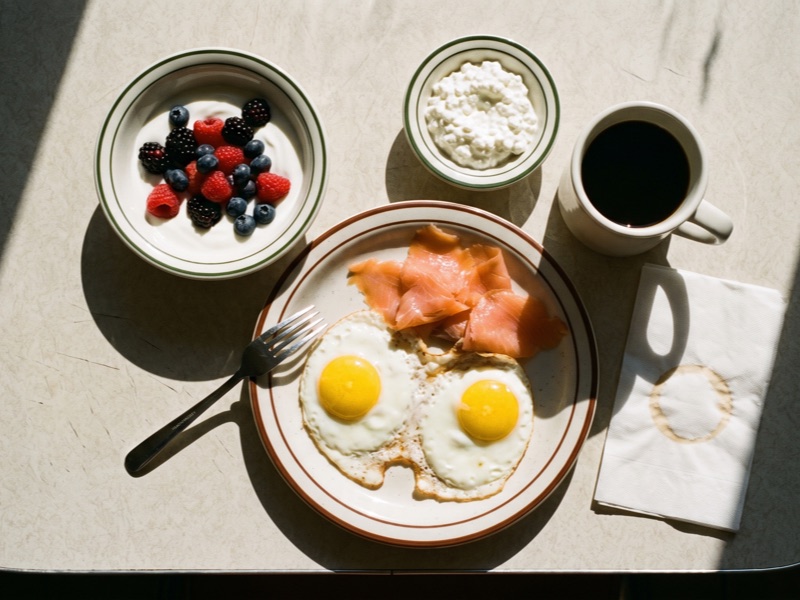
Protein at breakfast: the simplest change for stubborn belly fat
Why the first meal sets the day's hunger, what 30 grams looks like on a plate, and three breakfasts that get there without a shake.
Three grams a day, the most studied supplement in sports science, and a growing body of work on the brain.

You have probably seen the tubs. Creatine used to live next to the pre-workout, marketed to 22-year-olds who bench press. Now it shows up in your friend's kitchen, in your daughter's feed, and in conversations about menopause and memory.
If you are over 40, do not lift heavy, and wonder whether this is for you: that is the reader I had in mind. The short version is that creatine monohydrate is cheap, unusually well studied, and does one thing very reliably. The brain story is real but younger, and I will be honest about where it stands.
Your muscles run short, hard efforts (standing up from a low chair, carrying groceries upstairs, a set of squats) on a molecule called phosphocreatine. It recharges the cell's energy currency, ATP, in the first seconds of work. Your body makes some and you eat more in meat and fish; a typical diet supplies roughly 1 to 2 grams a day, according to Mayo Clinic.
A daily supplement tops up the muscle stores. That is the whole mechanism. It does not build muscle by itself; it lets you do a little more work each session and recover a little faster, and the extra work builds the muscle.
Women and vegetarians tend to start with lower stores, which is why the International Society of Sports Nutrition position stand notes that people who eat little or no meat often see larger changes when they supplement. A woman over 40 who eats mostly plants is, on paper, the person with the most to gain.
Strength and lean mass, with training. This is the settled part. A 2017 meta-analysis led by Philip Chilibeck pooled 22 randomized trials with 721 older adults (mean ages 57 to 70) who lifted two or three days a week for 7 to 52 weeks. The creatine groups gained about 1.37 kg, roughly 3 lb, more lean tissue than placebo and were stronger in upper- and lower-body tests. Modest on a scale; large for a 65-year-old keeping her independence.
Notice the condition: with training. Every trial behind those gains paired creatine with resistance exercise. Take the powder and change nothing else, and you should expect very little. It does not have to mean a barbell; bodyweight squats, bands and adjustable dumbbells twice a week count.
Memory and cognition. Here the evidence is promising, not settled. The brain uses creatine for the same energy-buffering job as muscle. A 2018 systematic review by Avgerinos and colleagues found signals for short-term memory and reasoning in healthy adults, strongest under stress such as sleep loss and in vegetarians. A 2024 meta-analysis of 16 trials with 492 participants reported small improvements in memory, attention and processing speed, and a 2023 analysis in Nutrition Reviews saw the clearest memory effect in adults aged 66 to 76.
Now the caveats. The trials are small, short, and use different tests, so the authors themselves warn the results are hard to pool, and the 2023 paper drew a published letter questioning its statistics. Nobody has shown that creatine prevents dementia or reverses memory loss, and no reputable researcher claims it. What you can honestly say: it is plausible, the early data lean positive, and the downside in healthy adults is small.
Dose. 3 to 5 grams of creatine monohydrate a day, one level scoop in almost every product. The ISSN and Mayo Clinic both land on this range for healthy adults.
No loading needed. You may read about loading with 20 grams a day for 5 to 7 days. It saturates muscles faster and the ISSN calls it safe, but 3 to 5 grams a day gets you to the same place in about four weeks with less stomach upset. Skip it.
Timing. Any time of day, with or without food, on rest days too. What matters is consistency, because the benefit comes from saturated stores, not from what you took an hour ago. I keep the tub next to the coffee.
Water weight. Creatine pulls water into muscle cells, and many people see the scale rise a pound or two in the first weeks. That is water inside the muscle, not bloating under the skin, and not fat. Know this before you start.
Kidneys. The question I get most, and for healthy adults the answer is reassuring. Creatine raises blood creatinine, the marker doctors use to estimate kidney function, because creatinine is what creatine turns into. A routine lab can look worse with no change in the kidneys. The ISSN review found no evidence of kidney harm at recommended doses in healthy people, and Mayo Clinic rates it likely safe for up to five years of use.
Who should ask first: anyone with diagnosed kidney disease, diabetes with kidney involvement, a history of kidney stones, or medications that affect the kidneys. Mayo Clinic notes that research in people with kidney disease is limited. Tell your clinician you take it either way, so a bumped creatinine does not trigger an unnecessary workup.
Fancy forms. Creatine HCl, buffered creatine, ethyl ester, "nano" creatine. The pitch is better absorption and less water retention at a smaller dose. The ISSN reviewed these claims and found no form that outperforms plain monohydrate, which is also the form used in nearly every trial above. The premium forms cost two to four times more per gram. Buy monohydrate.
Gummies and capsules. They work, but many gummies hold 1 to 1.5 grams each, so a dose is three to five gummies at $1 or more, versus about 15 cents as powder.
Creatine as a stand-in for exercise. Every meaningful muscle result in older adults came with resistance training. The powder is a helper, not a substitute.
Brain claims on the label. "Supports cognitive function" is legal wording that means almost nothing. Expect nothing you would notice day to day.
All four are plain creatine monohydrate at 5 grams per scoop. The math is price divided by servings at typical US retail; prices move, so treat them as ballpark.
The cheap option: 200 servings works out to about 13 cents a day, and micronized powder dissolves better than the old gritty stuff. The caveat is testing; BulkSupplements runs its own lab checks but does not carry NSF Certified for Sport, if you want an outside seal.
Creapure is the German-made monohydrate with the tightest purity spec, and this is one of the cheapest ways to get it: roughly 21 cents a serving over 200 servings, third-party tested. The caveat is that Nutricost's regular tub costs less for what is chemically the same molecule; you pay for the sourcing pedigree.
Creapure inside, NSF Certified for Sport on the outside, and a brand many clinicians already stock, which makes it the easy pick if you want a tub nobody will question. At about 45 cents a serving it costs three times the bulk bag for the same compound.
Also NSF Certified for Sport, unflavored, and a smaller tub if you want a two-month trial before committing to a kilo. The tradeoff is the highest cost per serving here, roughly 58 cents; once you know you will keep taking it, the bigger bags win.
What I do myself: a bulk bag, one scoop with morning coffee, dumbbells three times a week. The dumbbells do more of the work; the powder makes them go better.
This article is for general information and is not medical advice. It does not replace a consultation with a clinician who knows your history. Products are named because readers ask; we are not paid to name them unless a page says so. Editorial policy · Medical disclaimer
Why the first meal sets the day's hunger, what 30 grams looks like on a plate, and three breakfasts that get there without a shake.
Daylight saving time ends Sunday, November 1. Who feels it most, and the three-night plan that starts Thursday.
Blood sugar dips, cortisol answers, you're awake. How to read the pattern and the two dinner changes that quiet it.