

Clocks go back Sunday: how to reset your sleep in three days
Daylight saving time ends Sunday, November 1. Who feels it most, and the three-night plan that starts Thursday.
Vitamin D, B12, creatine and omega-3 have data. Collagen powder, most multivitamins and "immune blends" mostly have marketing.
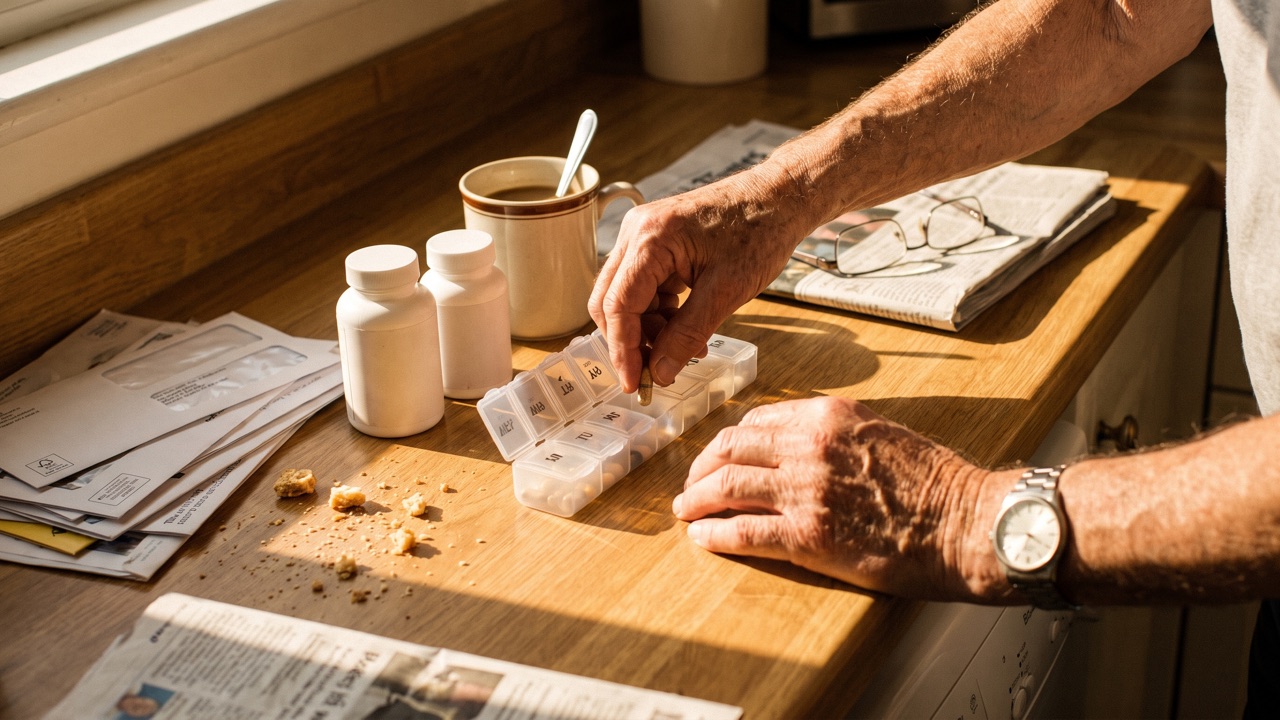
Open the cabinet above the coffee maker and count. Most readers who write to me about supplements take six to ten things a day, and when I ask which ones they could defend with a study, the list gets short fast.
After 50 the body does change in ways that supplements can address. Stomach acid drops, so B12 from food is absorbed less well. Skin makes less vitamin D. Muscle is harder to keep. But "something changes" is not "this pill fixes it," and that gap is where most of the money goes.
So here is the shelf audit I do with friends: seven with data behind them after 50, five to skip or demote, and what a month of each costs at a mainstream store.
1. Vitamin D, with a test first. The NIH Office of Dietary Supplements puts the daily allowance at 600 IU for ages 51 to 70 and 800 IU past 70, and calls a blood level of 20 ng/mL or above adequate for bone health. The catch: the big VITAL trial gave 2,000 IU a day to nearly 26,000 healthy adults for about five years and found no reduction in cancer or cardiovascular events. So this is a top-up for people who are low, not a shield. Ask for a 25-hydroxyvitamin D test before you commit, and stay under the 4,000 IU daily upper limit unless a clinician says otherwise.
2. Vitamin B12. Between 10 and 30 percent of older adults have trouble releasing B12 from food, which is why ODS recommends that people over 50 get most of their 2.4 mcg from fortified foods or a supplement. Two common drugs make it worse: metformin and acid reducers such as omeprazole. If you take either, B12 is the one supplement I would not skip. A cheap cyanocobalamin tablet does the job.
3. Creatine monohydrate, 3 grams a day. The International Society of Sports Nutrition's position stand calls creatine the most effective supplement available for increasing high-intensity exercise capacity and lean mass, and reports no harmful effects in healthy people at recommended doses. For our age group the point is hanging on to muscle. Three to five grams daily, no loading phase needed, plain monohydrate powder. Expect a pound or two of water weight early on.
4. Omega-3 (EPA and DHA), food first. Two servings of fatty fish a week cover most people, and ODS notes that the heart benefits are best established for fish itself. If you never eat fish, a capsule delivering around 1 gram of combined EPA and DHA is a reasonable stand-in. Keep expectations modest: in VITAL, 1 gram a day of omega-3 did not significantly reduce the combined rate of major cardiovascular events either.
5. Calcium, only if your diet is short. Women over 50 and men over 70 need 1,200 mg a day; men 51 to 70 need 1,000 mg. Count what you eat first, then fill only the gap with a 500 mg tablet, and stay under the 2,000 mg daily ceiling for adults over 50. More is not better here.
6. Protein powder, as a food gap-filler. This is a convenient food, not a vitamin. Many people over 50 eat almost all their protein at dinner and very little at breakfast. A scoop of whey or pea protein in the morning is the cheapest way I know to change that. Buy plain, unflavored powder.
7. Fiber, usually psyllium. Most Americans fall well short on fiber, and the shortfall shows up after 50 as constipation and rising LDL. Psyllium husk has decades of data on both. Start with one teaspoon in a full glass of water and build up over two weeks.
| Supplement | Typical daily dose | Who benefits most | Cost per month |
|---|---|---|---|
| Vitamin D3 | 1,000–2,000 IU | Tested low, little sun | $1–2 |
| Vitamin B12 | 500–1,000 mcg | Over 50, metformin or PPI users, vegans | $1–2 |
| Creatine monohydrate | 3–5 g | Anyone strength training | $3–5 |
| Omega-3 (EPA+DHA) | About 1 g | People who rarely eat fish | $10–30 |
| Calcium | 500 mg to close the gap | Low dairy intake | $2–4 |
| Protein powder | 20–30 g scoop | Low-protein breakfasts | $20–40 |
| Psyllium | 1–2 tsp | Low-fiber diets, constipation | $5–10 |
Most multivitamins. In 2022 the US Preventive Services Task Force reviewed the trials and found the evidence insufficient to say a daily multivitamin prevents heart disease or cancer in healthy adults. That is a polite way of saying the large trials showed little or nothing. A multivitamin is not dangerous, and it makes sense for someone eating very little. For most people it buys reassurance rather than results.
Collagen powders for skin and joints. The studies that show smoother skin or less knee pain are mostly small, short and paid for by the companies selling the powder. Collagen is a protein; your gut breaks it into amino acids like any other. Enjoy it in coffee if you like, but budget it as protein, not as a skin treatment.
"Immune blends." Zinc, elderberry, echinacea and vitamin C in one gummy with a shield on the label. None has good evidence for preventing infections in well-nourished adults, and the doses in blends are usually too low to matter.
Turmeric capsules without a clear reason. Curcumin has interesting lab data and inconsistent human data. If you are not tracking a specific joint complaint, you cannot tell whether it is doing anything. It can also interact with blood thinners, so mention it to your clinician if you keep it.
Antioxidant megadoses. This is the one with actual harm data. The USPSTF now recommends against beta-carotene and vitamin E supplements for preventing heart disease or cancer, because trials found beta-carotene raised lung cancer risk in smokers and vitamin E delivered no benefit. Food antioxidants are great. High-dose capsules are not the same thing.
Approximate prices at mainstream US retailers, September 2026. I have no relationship with any of these brands.
USP-verified, which matters for vitamin D because dosing errors are common. The caveat: 2,000 IU is more than the daily allowance, so get the blood test first; if you are not low, a 1,000 IU version is plenty.
Nearly a year's supply for the price of two lattes; B12 is water-soluble, so the excess is passed in urine. The caveat: 5,000 mcg is far more than anyone needs; half a tablet, or a 1,000 mcg brand, does the same job.
The cheap option: plain micronized monohydrate, the exact form used in the research, at roughly 15 cents a day. Thorne's creatine runs closer to $41 for 90 servings and adds third-party sport certification, which matters if you are drug-tested but not otherwise. The caveat: it comes in a bag, so buy a 3 g measuring spoon.
Two softgels deliver about 1,280 mg of omega-3s, with a lemon flavor that mostly prevents fishy burps. The caveat: it is the expensive way to get there; Kirkland Signature Fish Oil at Costco costs around $13 for 400 softgels, though you need more capsules to reach the same EPA and DHA.
Sort every bottle into three piles: has a test or symptom behind it, has a study behind it, has neither. The third pile goes in a drawer for a month; if nothing changes, it goes out. Bring the other two, plus your prescription list, to your next appointment, and ask for the D and B12 tests in the same blood draw.
This article is for general information and is not medical advice. It does not replace a consultation with a clinician who knows your history. Products are named because readers ask; we are not paid to name them unless a page says so. Editorial policy · Medical disclaimer
Daylight saving time ends Sunday, November 1. Who feels it most, and the three-night plan that starts Thursday.
Blood sugar dips, cortisol answers, you're awake. How to read the pattern and the two dinner changes that quiet it.
Dose, form, water weight, kidneys: the questions readers ask most, answered from the studies rather than the label.