
Clocks go back Sunday: how to reset your sleep in three days
Daylight saving time ends Sunday, November 1. Who feels it most, and the three-night plan that starts Thursday.
The cortisol-sugar loop is the best-supported explanation for middle-of-the-night wake-ups. A small change at dinner interrupts it, and it has nothing to do with melatonin.
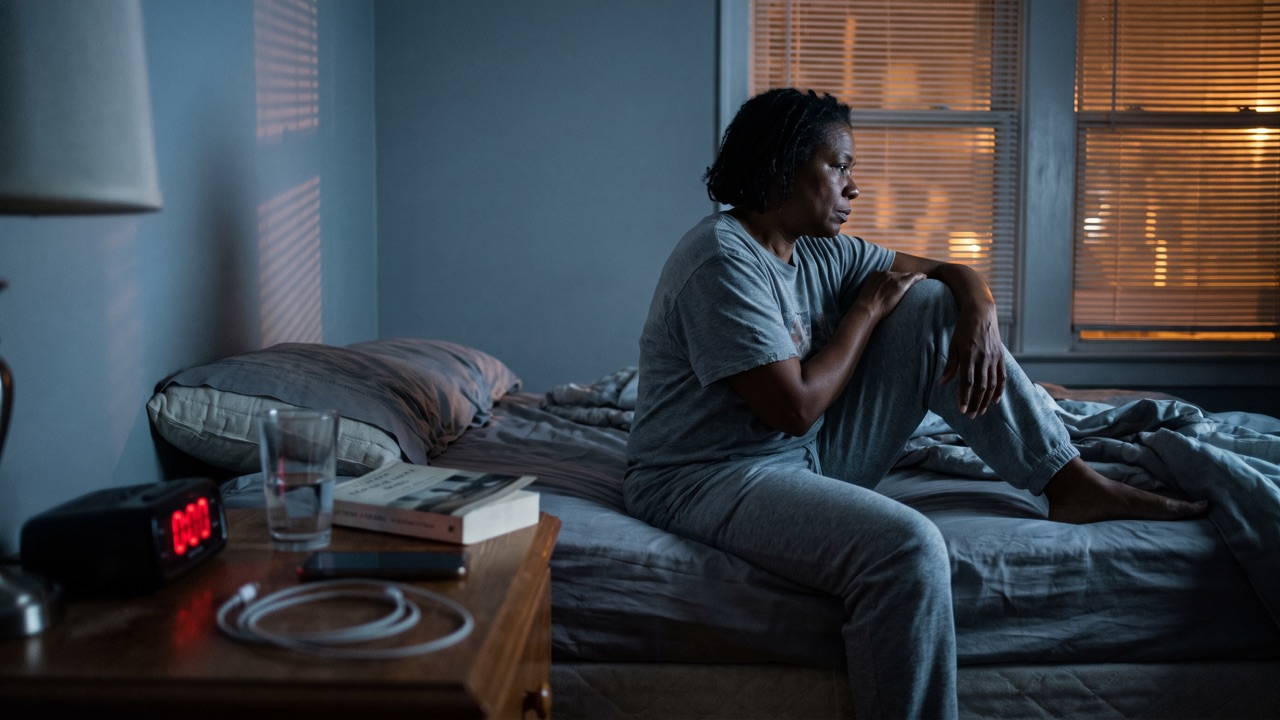
It is always the same hour. You went down fine at 10:30, and now the clock says 3:12 and you are wide awake, heart a little fast, mind already sorting tomorrow. You drop off around 5, and the alarm feels like an insult.
You are in a large club. In a Sleep Foundation survey, more than a third of US adults said they wake three or more nights a week. The 3 a.m. version has a particular flavor, though: you are not just awake, you are switched on. That is the clue. Falling asleep was never the problem; staying asleep is, and that has a lot to do with what happened at dinner.
Your brain runs on glucose all night without a meal; normally the liver covers it with a slow trickle of stored sugar. If blood sugar drifts lower than the body likes, it sends the stress hormones, adrenaline first, then cortisol, to push glucose back up. Those are emergency hormones, and they do their job.
The clearest human data is a University of Lübeck sleep-lab study that deliberately lowered blood sugar in 15 healthy young men while they slept. The counter-response (adrenaline, noradrenaline, ACTH and cortisol) kicked in, sleep got shallower at that moment, and most of the men showed signs of waking. The authors put it plainly: low blood sugar by itself has an awakening effect.
Two honest caveats: those were induced lows, deeper than a healthy person gets after dinner, and nobody has counted how many everyday 3 a.m. wake-ups start this way. It is a well-supported mechanism, not a proven headcount. But what makes the dip bigger is exactly what makes 3 a.m. worse.
Late, large dinners. In a randomized crossover trial at Johns Hopkins, 20 healthy volunteers ate the identical dinner at either 6 p.m. or 10 p.m. and slept 11 to 7 in the lab. After the late dinner, overnight glucose ran higher, the body burned less fat, and cortisol was higher, most of all in natural early sleepers. Sleep stages on the monitor did not change: this is about what your metabolism does under the sleep.
Alcohol. A drink knocks you out and bills you later. CDC guidance says alcohol "promotes sleep onset but causes early awakening and sleep disturbances," and to have it several hours before bed. The Sleep Foundation explains why: once the alcohol is metabolized, in the second half of the night, you get more of the lightest sleep stage and more wake-ups. Stop at least three hours before bedtime.
Menopause. Night sweats are the obvious culprit, but the National Institute on Aging notes that research now suggests waking from sleep may trigger hot flashes, rather than the other way around. NIA's advice: no large meals close to bedtime, a cool room, and no alcohol, because "even small amounts make it harder to stay asleep."
Finish eating about three hours before bed. Build the meal around protein and fiber rather than starch: a palm-sized portion of fish, chicken, tofu or beans (roughly 25 to 30 g of protein), plenty of vegetables, and a modest portion of slow carbs like lentils or sweet potato. Protein and fiber flatten the glucose rise, so the fall a few hours later is gentler. A big dessert at 9:30 p.m. is the thing to trade away.
If you eat early and still wake hungry or wired, add a small snack 30 to 60 minutes before lights-out. Not carbs alone, which spike and drop, but protein with a little fat: a half-cup of plain Greek yogurt, some cottage cheese, a hard-boiled egg or a small handful of almonds, under about 150 calories. Try it for two weeks and note when you wake. If nothing changes, drop it; it is a test, not a rule.
Do not check the clock. Turn it to the wall and leave the phone across the room. Knowing it is 3:14 hands your brain a math problem ("four hours left, three if I fall asleep now") and a fresh shot of stress hormone. Lie still, eyes closed, breathe slowly, and let the wake-up be boring.
If you are fully awake for what feels like 20 minutes or more, get up, keep the light dim, do something dull, and come back when sleepy. That is the core of cognitive behavioral therapy for insomnia (CBT-I), which NIA recommends and which works at any age.
An over-the-counter continuous glucose monitor for adults not on insulin; a month of wearing it shows whether late dinners or wine nights come with an overnight dip before the wake-up. It is not made for people with problematic low blood sugar, and it fixes nothing by itself.
Glycinate is the form most people tolerate in the evening, and this is a USP-verified version at a fair price. The sleep evidence for magnesium is a few small, short trials with modest results, so treat it as a maybe, and stay under the NIH Office of Dietary Supplements ceiling of 350 mg a day from supplements.
The entry-level sunrise alarm: a 30-minute simulated dawn plus a dim bedside lamp you can use at 3 a.m. without waking yourself further. No sunset mode or nature sounds; the HF3520 adds those for about twice the price.
The cheap option, and where I would start: a half-cup delivers about 9 g of protein and some fat with almost no sugar, exactly the profile for a pre-bed snack. Any plain 2% or full-fat Greek yogurt works; skip flavored cups, which carry 10 to 15 g of added sugar.
The cortisol-sugar loop has good lab support and no trial showing that changing dinner alone cures 3 a.m. waking. We are confident about the direction and honest that the size of the effect for any one person is unknown, which is why the two-week test matters more than any study.
We would skip "cortisol blocker" and "adrenal support" supplements; there is no good evidence they lower nighttime cortisol or keep you asleep. Skip the nightcap, and skip a carb-only snack like a bowl of cereal at 10 p.m., which sets up the very spike-and-dip you are trying to avoid.
Melatonin is a timing signal: it tells the body the night has started, which is why it can help with jet lag or a shifted schedule. A 3 a.m. wake-up happens when your own melatonin is already circulating, and adding more rarely changes the second half of the night. The NIH's complementary health center is blunt: there is not enough strong evidence on the effectiveness or safety of melatonin for chronic insomnia.
Quality is a separate issue. In a 2017 analysis of 31 products, the content often did not match the label and 26 percent contained serotonin; a 2023 test of gummies found 74 to 347 percent of the labeled dose. If it helps you fall asleep, fine. Just do not expect it to fix 3 a.m.
See a clinician if the wake-ups come with snoring or gasping (a sleep apnea sign), chest pain or a pounding heart, or if you take insulin or a sulfonylurea and wake sweaty and shaky. That can be real nighttime hypoglycemia and needs a medication review, not a yogurt; never change a prescription on the strength of an article.
This article is for general information and is not medical advice. It does not replace a consultation with a clinician who knows your history. Products are named because readers ask; we are not paid to name them unless a page says so. Editorial policy · Medical disclaimer
Daylight saving time ends Sunday, November 1. Who feels it most, and the three-night plan that starts Thursday.
A shelf audit with prices: what the trials support after 50, what they don't, and what a month of each actually costs.
Dose, form, water weight, kidneys: the questions readers ask most, answered from the studies rather than the label.