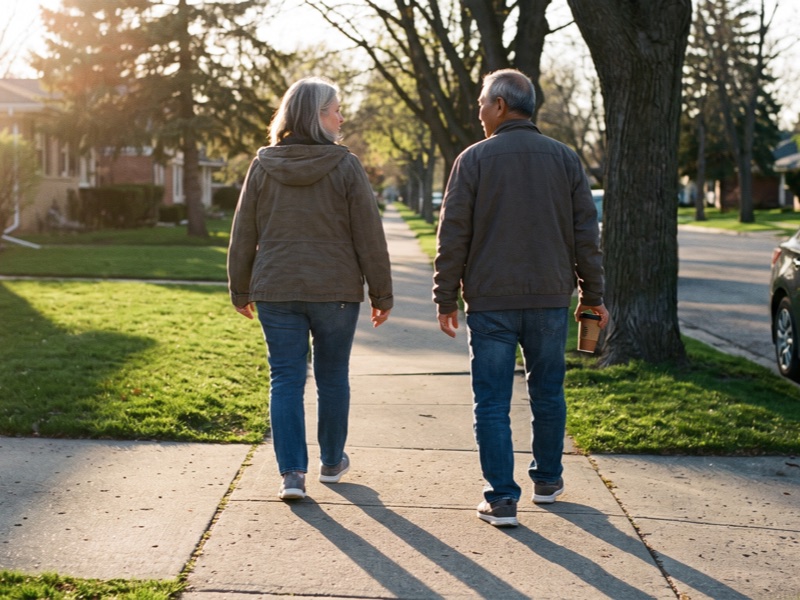
The 10-minute walk after meals: what it does to your blood sugar
The trial numbers, why timing matters more than distance, and how to fit three short walks into a normal workday.
Enter your age, and optionally your resting pulse, to get your estimated max heart rate and five training zones, with the Karvonen version and the honest limits of any formula.
Max heart rate is estimated with the Tanaka formula (208 − 0.7 × age); the 220-minus-age figure is shown for comparison. Real maximums vary by 10 to 12 beats either way, and beta-blockers lower them further, so treat the zones as a starting range and confirm them with the talk test.
A heart rate zones calculator starts with your estimated maximum heart rate, the fastest your heart can beat at all-out effort. We estimate it from age with the Tanaka formula, 208 minus 0.7 times your age, and show the older 220-minus-age rule beside it.
The five zones are percentages of that max, from 50 to 60 percent in zone 1 up to 90 to 100 percent in zone 5. A 60-year-old has an estimated max of 166, so zone 2 runs from about 100 to 116 beats per minute.
If you enter a resting heart rate, the calculator also shows the Karvonen version, built on heart-rate reserve: max minus resting, with each zone a percentage of that reserve added back on top of resting. The same 60-year-old with a resting pulse of 65 gets a Karvonen zone 2 of 126 to 136, about 20 beats higher. Neither is wrong; they are different scales, and the American College of Sports Medicine defines moderate exercise as 40 to 59 percent of reserve.
Count your pulse for 60 seconds before getting out of bed on three mornings and average them; 60 to 100 is normal for adults.
The percentages matter less than what each zone feels like; the talk test needs no strap.
| Zone | % of max HR | Purpose | How it feels |
|---|---|---|---|
| Zone 1 | 50 to 60% | Warm-up, recovery, easy walks | You could sing. |
| Zone 2 | 60 to 70% | Endurance base, long steady sessions | Full sentences, could go an hour. |
| Zone 3 | 70 to 80% | Tempo, brisk hills | Short sentences only. |
| Zone 4 | 80 to 90% | Intervals of 2 to 8 minutes | A few words at a time. |
| Zone 5 | 90 to 100% | Sprints of 30 to 90 seconds | No talking. |
The American Heart Association calls 50 to 70 percent moderate and 70 to 85 percent vigorous; most of the health benefit after 40 comes from time in the moderate band.
| Age | Tanaka (208 − 0.7 × age) | Classic (220 − age) |
|---|---|---|
| 40 | 180 | 180 |
| 45 | 177 | 175 |
| 50 | 173 | 170 |
| 55 | 170 | 165 |
| 60 | 166 | 160 |
| 65 | 163 | 155 |
| 70 | 159 | 150 |
| 75 | 156 | 145 |
The 220-minus-age rule was never derived from a proper study. In 2001 Tanaka, Monahan and Seals pooled 351 studies and confirmed the result in 514 adults: max heart rate falls more slowly with age than the old rule assumes, so 220-minus-age reads too low after 40 and drags every zone down with it.
Heart rate zone 2 training is steady effort you can hold for 45 to 90 minutes while still talking. At that intensity your muscles burn mostly fat and lean on the mitochondria, the parts of the cell that turn fuel into energy. Do a lot of it and you build more of them; that is an endurance base, and it is easy to recover from.
One honest correction on the fat burning heart rate idea: burning a higher share of fat during a session does not mean losing more body fat overall. A harder workout burns more total calories in the same minutes. Zone 2 earns its place because it is sustainable and good for your heart, not because it melts fat.
Your real max is probably not the formula's max. Individual maximums scatter about 10 to 12 beats above and below any age prediction, Tanaka's included. If zone 2 feels like a race, trust the talk test and shift the numbers.
Medication lowers the ceiling. Beta-blockers, prescribed for blood pressure, heart rhythm and after heart attacks, lower both resting and maximum heart rate, sometimes by 20 to 30 beats; some calcium-channel blockers do the same. On these drugs every zone here is wrong. Use the talk test, ask the prescriber what range makes sense, and never adjust a dose to fit a workout.
Wrist sensors lag and misread. In a 2017 study in Medicine & Science in Sports & Exercise, a chest strap tracked the medical ECG almost perfectly while wrist devices varied by brand and activity, with the largest errors during changing intensities. A wrist tracker is fine for steady zone 2 walks; for intervals, a chest strap is the accurate tool.
Chest pressure, unusual breathlessness, fainting, a diagnosed heart condition, or a resting pulse that has changed noticeably in recent weeks belong in front of a clinician before zone 4 or 5 work. So does being over 60 and sedentary for years: zones 1 and 2 can start now; hard efforts wait for a check-up.
Not a ranking, in no particular order. How we make money.
Chest strap that pairs with almost any watch or phone app and is the reference most wearable studies compare against; the strap needs wetting before a run and a new battery about once a year.
Slim wrist tracker with all-day and resting heart rate, zone minutes and a ten-day battery; accurate enough for steady walks, less so during intervals, and the app's best features sit behind a subscription.
The cheap option: optical heart rate, resting-pulse trends and zone alerts with a battery that lasts two weeks; the app is clunkier than Fitbit's and the sensor lags on sudden efforts like any wrist device.
Estimate your max heart rate first: 208 minus 0.7 times your age (Tanaka). Then take percentages of that number: 50 to 60 percent is zone 1, 60 to 70 zone 2, 70 to 80 zone 3, 80 to 90 zone 4 and 90 to 100 zone 5. For a 55-year-old the max is about 170, so zone 2 runs from roughly 102 to 119 beats per minute.
With an estimated max of 173, zone 2 is about 104 to 121 beats per minute. If your resting pulse is 60, the Karvonen method gives a higher range of about 128 to 139. Whichever you use, you should still be able to speak in full sentences; if you cannot, slow down regardless of the number.
Karvonen bases zones on heart-rate reserve, the gap between your maximum and resting heart rate. Target = resting + (max − resting) × intensity. Because it accounts for fitness through the resting pulse, its zones run 15 to 25 beats higher than plain percent-of-max zones. It dates to a 1957 training study by Martti Karvonen and is still used in ACSM guidelines.
Partly. At lower intensities a larger share of the calories you burn comes from fat, which is where the name comes from. But a harder workout burns more calories in total, and body-fat loss over months depends on your overall energy balance, not the fuel mix during one session. Zone 2 is worth doing for endurance and heart health, not as a fat-loss trick.
It was never derived from a formal study, and a 2001 analysis of 351 studies found that max heart rate declines more slowly with age than the rule assumes. The result is that 220-minus-age underestimates max heart rate in people over 40, by about nine beats at age 70, and sets their training zones too low. The Tanaka formula, 208 minus 0.7 times age, fits the data better.
Yes. Beta-blockers lower both resting and maximum heart rate, often by 20 to 30 beats, so any age-based zone calculator will overestimate your targets. Use perceived effort and the talk test instead, and ask the prescribing clinician what heart rate range is reasonable for you. Do not adjust the medication to fit a workout plan.
This calculator is for general information and is not medical advice. Results are estimates from population formulas and can be off for you personally. Talk to a clinician before acting on a number, especially if you take medication or have a diagnosed condition. Editorial policy · Medical disclaimer
The trial numbers, why timing matters more than distance, and how to fit three short walks into a normal workday.
Dose, form, water weight, kidneys: the questions readers ask most, answered from the studies rather than the label.
Bone density, hearing, colon, eyes, skin, blood pressure, vaccines, strength. Eight appointments, one year, with what each one catches.