Protein at breakfast: the simplest change for stubborn belly fat
Why the first meal sets the day's hunger, what 30 grams looks like on a plate, and three breakfasts that get there without a shake.
Find out how much protein you should eat per day, in grams, based on your weight, your age and whether you want to lose fat, build muscle or simply stay strong.
This is a daily total in grams, split across 3–4 meals. It assumes healthy kidneys; if you have kidney disease, ask your clinician for a target instead.
The math is simple: your body weight in pounds times a factor that depends on what you are trying to do and how old you are. That is how the Dietary Reference Intakes and the sports-nutrition literature both frame it.
The floor is the RDA, 0.36 g per pound (0.8 g per kg). That number was set to prevent deficiency in a sedentary adult, not to help you keep muscle while dieting or lifting. Active adults land at 0.55–0.7 g per pound. If you are trying to build muscle, or lose fat without losing muscle, the range moves up to 0.7–1.0 g per pound. Adults 65 and older get their own row: 0.45–0.55 g per pound (1.0–1.2 g per kg), the range the PROT-AGE study group recommends for healthy older people.
One line of math, using a 160 lb adult who lifts twice a week: 160 × 0.7 = 112 g a day. The calculator also splits that total across your meals, because 25–40 g per sitting is what the muscle-building response seems to want. And if your BMI is over 30, it uses a goal weight instead of your current weight, so the target does not balloon with body fat that does not need feeding.
Find your row. Most people belong in the second or third one, and "protein for weight loss" is the third row, not the first — you want more protein when calories go down, not less. Women use the same factors as men; the totals come out lower only because body weight is usually lower.
| Goal / age | g per lb | g per kg | Example: 150 lb (68 kg) |
|---|---|---|---|
| RDA minimum (sedentary) | 0.36 | 0.8 | 54 g |
| Active, general health | 0.55–0.7 | 1.2–1.6 | 83–105 g |
| Muscle gain, or fat loss while keeping muscle | 0.7–1.0 | 1.6–2.2 | 105–150 g |
| Adults 65+, healthy | 0.45–0.55 | 1.0–1.2 | 68–83 g |
The 0.7 g per pound number is not arbitrary. In the 2018 meta-analysis by Morton and colleagues, 49 resistance-training trials pooled together showed gains in lean mass leveling off at about 1.6 g per kg per day. Above roughly 1 g per pound, no controlled study has shown extra muscle from extra protein in healthy adults.
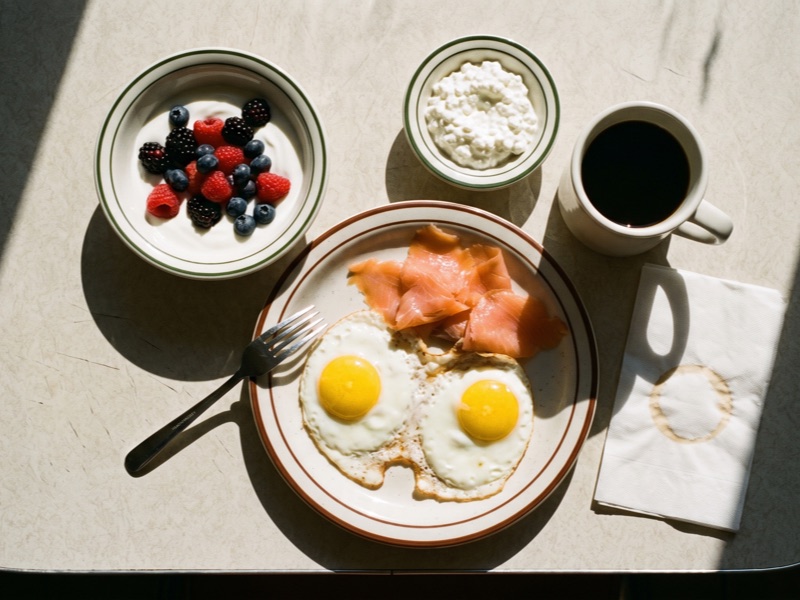
Once you have a daily number, the practical question is what 30 g is on a plate. Each portion below lands at about 30 g.
| Food | Portion for about 30 g |
|---|---|
| Chicken breast, cooked | 4 oz (a palm-sized piece) |
| Plain Greek yogurt | 1 heaping cup (about 10 oz) |
| Eggs, large | 4–5 whole eggs |
| Firm tofu | 10 oz (two-thirds of a block) |
| Lentils, cooked | 1½ cups |
| Whey or pea protein powder | 1 scoop plus a cup of milk |
Kidney disease. If you have chronic kidney disease, this calculator is not for you. People with CKD who are not on dialysis are usually asked to eat less protein, not more, and the target belongs to your nephrologist or renal dietitian. In healthy kidneys, intakes up to about 1 g per pound have not shown harm in trials, but nobody has studied decades of it.
Very high intakes. Beyond 1 g per pound the benefit curve is flat. More protein at that point mostly means fewer calories left for fiber, fruit and fat, and a grocery bill that grows faster than your muscle.
Plant protein. Grams are not all equal. Most plant proteins carry less leucine, the amino acid that switches muscle building on, and are digested less completely. If you eat mostly plants, aim for the top of your range, lean on soy and pea, and mix sources across the day.
Body fat. The factor multiplies body weight, and fat tissue needs very little protein. That is why the tool switches to goal weight above a BMI of 30.
Powder is food, not a supplement. Whey and pea protein are dried milk and dried peas. They do nothing a chicken breast cannot; they are simply faster and, per gram, often cheaper.
Not a ranking, in no particular order. How we make money.
25 g protein per scoop for roughly $1.65 a serving; the isolate is easier on lactose-sensitive stomachs, and the 5 lb tub brings the per-serving cost down further.
21 g per two-scoop serving from pea, brown rice and chia, about $1.40 a serving; expect a grittier texture than whey and a slightly lower leucine dose per scoop.
About 18 g protein per 7 oz, the cheapest protein per gram on this page and a food, not a powder; the 5% version is more filling than the 0%, at about 190 calories per serving.
Multiply your body weight in pounds by 0.55 to 0.7 if you are active, or by 0.7 to 1.0 if you are trying to build muscle or lose fat without losing muscle. The RDA of 0.36 g per pound is the minimum to avoid deficiency, not an optimal target. A 150 lb adult who exercises lands somewhere between 83 and 105 g a day.
The factors per pound are the same for women and men. Women's daily totals usually come out lower simply because body weight is usually lower. Pregnancy and breastfeeding raise needs; a prenatal dietitian or your OB should set that number.
More than you need at maintenance, not less. When calories drop, protein at 0.7 to 1.0 g per pound of goal weight helps you keep muscle while you lose fat and keeps you fuller. If your BMI is over 30, base the calculation on a realistic goal weight rather than your current weight.
The PROT-AGE study group recommends 1.0 to 1.2 g per kg per day for healthy older adults, which is 0.45 to 0.55 g per pound, spread over meals of 25 to 30 g each. That is above the RDA because aging muscle responds less to each meal. People with acute or chronic illness may need more, decided with a clinician.
About 0.7 g per pound, or 1.6 g per kg, is where lean-mass gains leveled off in a 2018 meta-analysis of 49 resistance-training trials. Going up to 1 g per pound is reasonable during a diet or hard training block. Beyond that, trials have not shown extra muscle.
In people with healthy kidneys, intakes up to about 1 g per pound have not shown harm in controlled trials, though long-term data are limited. In people who already have chronic kidney disease it is a different story: they are usually asked to eat less protein, and the target should come from a nephrologist or renal dietitian.
This calculator is for general information and is not medical advice. Results are estimates from population formulas and can be off for you personally. Talk to a clinician before acting on a number, especially if you take medication or have a diagnosed condition. Editorial policy · Medical disclaimer
Why the first meal sets the day's hunger, what 30 grams looks like on a plate, and three breakfasts that get there without a shake.
Dose, form, water weight, kidneys: the questions readers ask most, answered from the studies rather than the label.
A shelf audit with prices: what the trials support after 50, what they don't, and what a month of each actually costs.