

Retinal vs. retinol: the one-step difference dermatologists talk about
The retinoid ladder explained in plain English, with the concentrations that matter and the products that actually list them.
Polydeoxyribonucleotide started as a wound-healing drug. Now it's in serums and eye patches. What the injectable data says, and what a cream can borrow from it.
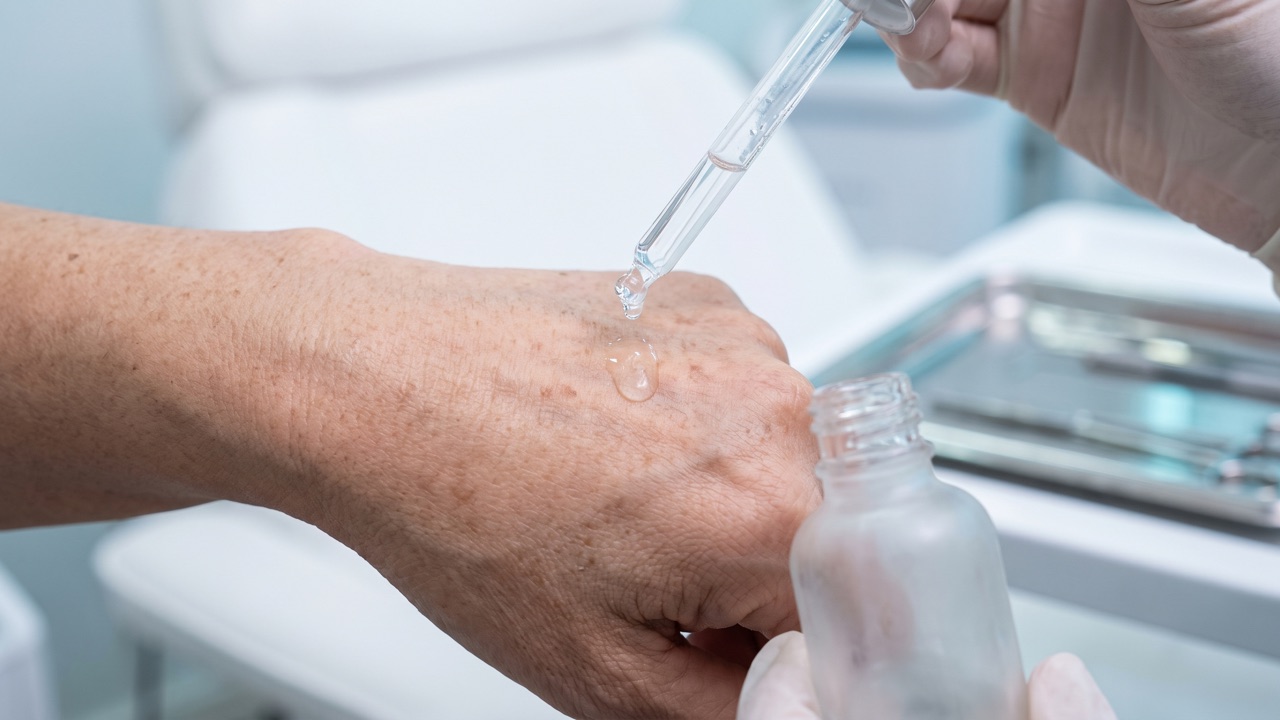
If you have shopped for a serum in the last year, you have seen the pink bottles. PDRN, "salmon DNA," "skin booster in a jar." The ingredient went from Seoul dermatology clinics to Ulta shelves in about eighteen months, and the marketing arrived faster than the explanations.
So here is the honest version. PDRN is a real pharmaceutical with a real mechanism and a decent stack of injectable studies behind it. It is also an ingredient whose topical evidence is thin, whose concentration almost no brand discloses, and whose name on a label can mean two rather different things.
I spent a week in the literature and on the ingredient lists. This is what I would want to know before spending $22 or $60 on it.
PDRN stands for polydeoxyribonucleotide. It is a fragment of DNA, typically 50 to 1,500 base pairs long, purified from the sperm cells of chum salmon or trout. In Italy the compound has been a registered drug for decades under the brand name Placentex, used in injectable and topical forms for tissue repair, most notably in hard-to-heal wounds such as diabetic foot ulcers.
A 2017 review in Frontiers in Pharmacology by Squadrito and colleagues describes the pharmacology in detail. The key point: PDRN is not "feeding your skin DNA." It binds to the adenosine A2A receptor on cells, which nudges up cyclic AMP and downstream growth factors such as VEGF, supporting new blood-vessel growth and collagen production. Once the fragments are broken down, the freed-up nucleotides also feed the so-called salvage pathway, which cells use to rebuild DNA under stress. Both effects are shown in cell and animal models; the wound-healing benefit is shown in trials of the drug.
Korea took the drug and turned it into an aesthetic. Rejuran, the best-known injectable "skin booster," is a polynucleotide gel micro-injected into the dermis of the face, usually in three or four sessions a month apart.
The injectable literature is small but not nothing. A 2024 review in the International Journal of Molecular Sciences summarized the aesthetic use of polynucleotides and concluded they have been used to improve skin texture and reduce wrinkle depth, while calling out "a scarcity of high-quality, large-scale randomized controlled trials."
A 2026 systematic review in Cureus did the counting. It found seven randomized trials with a combined 183 participants across skin rejuvenation, scar prevention and wound healing. Four of the seven were rejuvenation studies. Across them, PDRN and polynucleotide injections improved wrinkle-related outcomes and patient satisfaction; one trial that paired microneedling with PDRN reported a 57 percent reduction in wrinkle severity, better than platelet-rich plasma in the same study.
Now the caveats, from the same review. Sample sizes ranged from 10 to 42 people. Follow-up ran from two weeks to six months. Protocols differed from study to study, and one of the wound-healing trials was manufacturer-sponsored with a high risk of bias. Side effects were mostly swelling, bruising and redness at the injection sites. So: promising, consistent in direction, and still far from the kind of data behind, say, tretinoin.
This is the part the ads skip. Every study above put the molecule into the dermis with a needle. PDRN fragments are large, water-loving molecules, and the outer layer of your skin exists specifically to keep large, water-loving molecules out. There is no good evidence that a meaningful amount of PDRN in a cream reaches the fibroblasts that the A2A receptor story depends on.
That does not make PDRN creams useless. It makes them cosmetics. What a well-made PDRN serum can plausibly do is what its base formula does: hyaluronic acid and glycerin pull in water, peptides and niacinamide support the barrier, and skin that is properly hydrated looks visibly smoother and plumper within days. Some lab work suggests DNA fragments on the skin surface can bind water and calm irritation, which would fit that picture. "Visibly firmer in 4 weeks" is a claim a cream can earn. "Regenerates skin cells" is not, and by FDA's own definition a product marketed that way is being sold as a drug, not a cosmetic, whether or not it has been tested like one.
Three things to check before you pay for the pink bottle.
On a US ingredient list, PDRN usually appears as Sodium DNA; "PDRN" is a pharmaceutical term and often a trademark. Where it sits in the list matters. Ingredients are ordered by concentration down to 1 percent, so Sodium DNA near the bottom, after the fragrance and preservatives, is a trace.
Almost no brand discloses how much PDRN is in the formula. "99% pure" on a label refers to the purity of the raw material the manufacturer bought, not the percentage in the jar. "Highest level available" is a comparison the brand is making against itself. Treat concentration as unknown unless a number is printed.
Not every "PDRN" is salmon DNA. Some vegan versions use plant-derived nucleotides, sometimes labeled "Rose PDRN" or similar. That is fine if you want to avoid animal ingredients, but it is a different molecule from the one in the studies.
Not a ranking. Four products we would buy ourselves, in no particular order, each with the plus and one honest caveat. How we make money.
The plus: the bottle that started the US trend, pairing salmon Sodium DNA with peptides and niacinamide in a light, fast-absorbing serum at a friendly price. The caveat: it comes in a salmon version and a vegan “Rose PDRN” version in nearly identical packaging, so read the front of the box.
The plus: a 60 ml moisturizer rather than a serum, so salmon PDRN, a peptide, a collagen complex and pink algae extract come in one step; a good fit if you want a single evening product instead of a serum plus cream. The caveat: like every product on this list it does not print a PDRN percentage, and the brand’s “9 in 10” figures are from a user survey, not a trial.
The plus: fragrance-free and hyaluronic-acid-forward, with the PDRN encapsulated in visible beads; a strong pick if hydration is the goal and your skin is reactive. The caveat: “Capsule 100” describes the encapsulation, not a concentration.
The plus: the topical line from the company behind the injectable, built around its trademarked c-PDRN with hyaluronic acid, and the most elegant texture of the four. The caveat: the shared name does not transfer the injection data to the bottle, and the concentration is undisclosed here too.
There are, as of this writing, no large independent randomized trials of a topical PDRN product against a matched serum without it. The topical studies that exist are small, mostly Korean, often brand-funded, and typically measure hydration and texture over a few weeks. That is consistent with "a good hydrating serum," which is what I think these are.
Who should bother: anyone who wants a gentle, well-formulated hydrating serum and is curious. Dry, dull or post-procedure skin is the most plausible fit. Who can skip it: if you already use a hyaluronic serum you like, PDRN is not a reason to switch. And if your goal is real wrinkle reduction, the evidence points to the syringe in a dermatologist's office, or to tretinoin and sunscreen, not to the pink bottle.
One safety note. PDRN is derived from fish. Allergic reactions to the purified DNA appear to be rare, but if you have a serious fish allergy, patch-test first or ask your allergist.
This article is for general information and is not medical advice. It does not replace a consultation with a clinician who knows your history. Products are named because readers ask; we are not paid to name them unless a page says so. Editorial policy · Medical disclaimer
The retinoid ladder explained in plain English, with the concentrations that matter and the products that actually list them.
A two-minute mirror test, what causes each, and which ingredients have evidence for which problem.
Oleic acid, stearic acid and the barrier question. What the trend gets right, what it ignores, and who should skip it.